A Jewellery Set and a Coincidence
This necklace and earring set – pearls clustered to evoke grapes with gold vine leaves – has travelled far and wide. Between 1849 and 2015 it went from England to Mauritius to Australia, to East Africa, to Spain and finally back to Australia (where it will remain)!
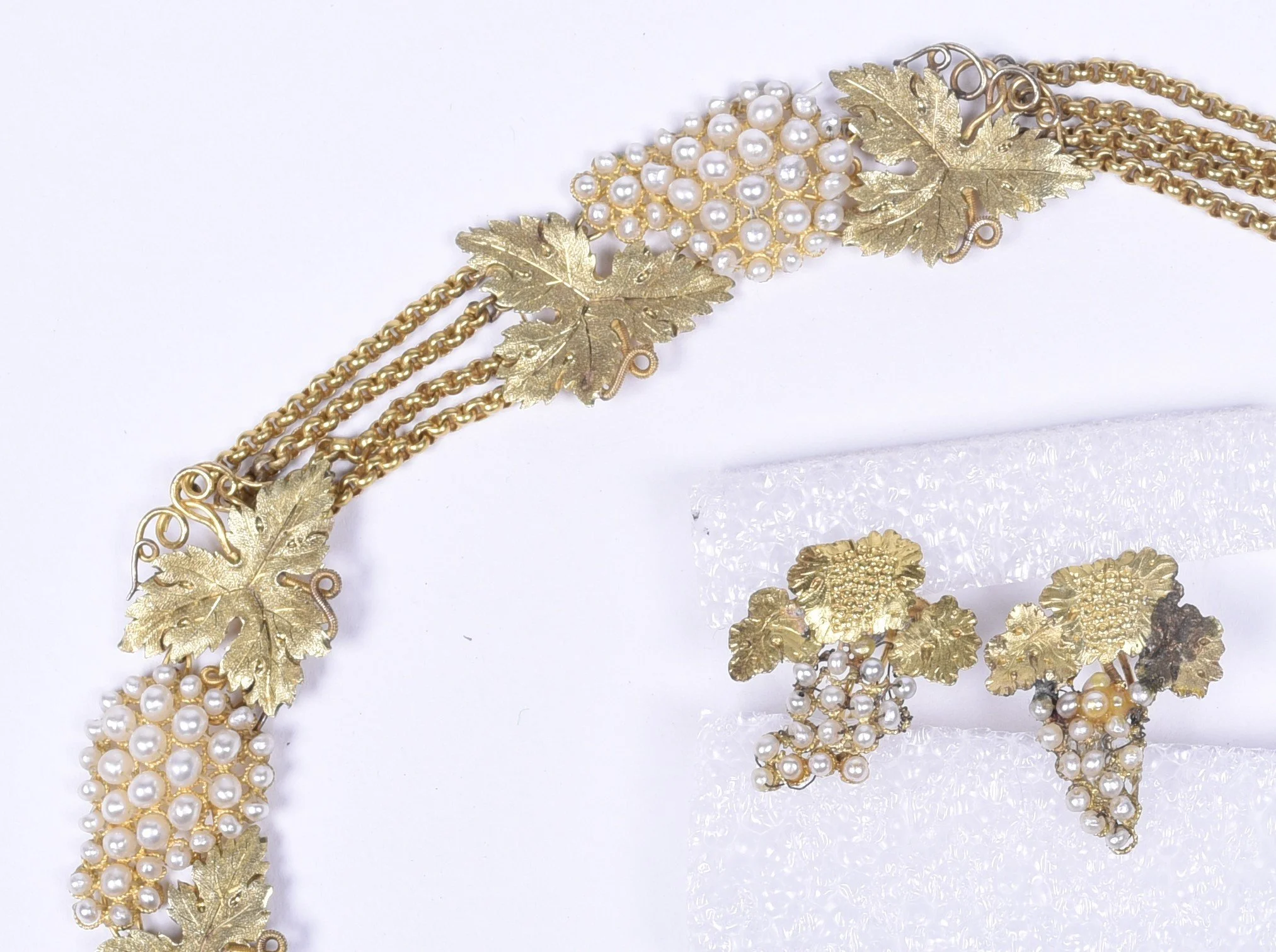
Explaining those multiple journeys will come, but first I want to celebrate coincidences – those moments in life that feel less like chance and more like the universe offering a sign that something is ‘meant to be’. Certainly, we all have different opinions about whether coincidences really are just sheer chance; personally I like the universe idea and, for me, this jewellery is a perfect, if circuitous, example.
To explain: a few years ago, I was living in Alverstoke, UK, a small village on England’s south coast, near Portsmouth Harbour, and home over the years to naval officers. While living there, I wrote my first book Resolution, whose key protagonist, was a young naval officer, Lord Robert Manners, who served in the American War of Independence (1776-83). He used to anchor his ship close to Alverstoke seafront –Stokes Bay – during the 1770s. When I took my daily walk along Stokes Bay, I would imagine him there, aboard a huge 74-gun ship with some 700 sailors, waiting for the tide before sailing to seek battle. The coincidence was chance, yet still explainable. My maritime background had led me first to Alverstoke and then to Resolution. It reinforced my ‘meant to be’ feeling.
However, soon came another coincidence much more ascribable to sheer chance. After completing Resolution, I began a new project documenting the adventures of a family of colonial pioneer sheep farmers who had settled in Western Australia from 1840, principal founders of the region’s pastoral industry. Although my research covered the days when people travelled by ship, little else in the story pertained to matters maritime.
This colonial family owned the jewellery set. Such items were fashionable in Victorian England, when grape-pearl clusters and vine leaves, an ancient symbol of abundance and fertility, enjoyed a revival in the mid-nineteenth century. However, this set slightly pre-dates that period, as I was to learn through surviving family member and owner, Jeannine Cook.
Jeannine explained to me that it was worn in England in 1819 by her great-great-great grandmother, Elizabeth Lawrence, at her wedding to Joseph Bingham Clifton. However, Jeannine could not recall much else, having not looked at her family archive for many years.
That archive was located on the Spanish island of Mallorca. I travelled from Alverstoke to Mallorca to delve into the many boxes of papers relating to Jeannine’s family’s trajectory (mirroring the jewellery) from England to Western Australia to East Africa and eventually to Mallorca. Imagine my surprise as I sat in the library of a Mallorca villa to discover history of Alverstoke. I delved further. It turned out that Joseph Bingham Clifton hailed from Alverstoke. His father, the Reverend Francis Clifton, had been a Royal Naval Chaplain but by 1783, had left the Royal Navy and settled in Alverstoke, where Joseph was born in 1797.
Francis was appointed as a curate of St Mary’s Church, Alverstoke. For years, I had seen that same church from my bedroom window and hear its bells chiming through the night, with no idea whatsoever of the connection I would one day have with its history. I even discovered that Francis was buried near the village’s parish hall - I suspect, after investigation, under a flower bed alongside which I had often parked my car. What are the chances of that connection, I thought, discovering the history of my own village in an apparently utterly different context?
I even learned that another of Francis Clifton’s sons, Marshall Waller Clifton, had emigrated to Western Australia in the nineteenth century. In 1842, he established the first farm in an area south of Perth, naming it Alverstoke, after his birthplace.
And there’s more! It turned out that another branch of Jeannine’s direct forebears, John Randall Peckham, had drowned in Stokes Bay, in 1811. read a harrowing description of the tragic accident, realising that over many years, I had been gazing unknowingly at that spot, one in fact close to where Lord Robert Manners used to anchor some quarter of a century earlier.
I leave it to you as the reader to decide whether I am fanciful in thinking that my moving to Alverstoke and then uncovering connections between this village and my subsequent work meant that my own life’s trajectory was ‘meant to be’ – or was it all, really, just sheer chance?
*
As for the jewellery set itself, Joseph Bingham Clifton died young in England, but his son, William Carmalt Clifton, eventually inherited it. William travelled to Mauritius and then settled in Albany, Western Australia, in 1851. There, the jewellery was inherited by Jeannine’s great-grandmother. Jeannine’s grandparents later took it to East Africa. Eventually, during the lead-up to Tanganyika’s 1961 independence, it was taken to Mallorca where the family found an alternative home.
Jeannine chose to wear it at her own wedding in Palma, together with Elizabeth Lawrence Clifton’s wedding dress, in 1970. Forty-five years later, she donated all those items to the permanent collections of the Western Australia Museum, Perth.