A Wartime Engagement
In April 2026, when attending a literary festival in Bibury, England, I happened to be sitting near a lady wearing an elegant blue shirt. When she turned to me with an open smile, I said, ’I’ve been admiring your shirt.’ She explained that it was made of Liberty silk, connected with her job at London’s Victoria & Albert Museum. That was my introduction to Helen Molesworth, a renowned jewellery historian and gemmologist.
Helen went on to say she had written a book called Precious, about which she would be speaking at the festival. ‘I have just bought your book,’ I exclaimed. It had caught my eye on the festival book sales table because I had grown interested in gemstones while writing my own book, To Africa for a Rose. I was still unaware that Helen and I shared a further connection – she was born in Kenya, East Africa.
My book is about a family also from East Africa, but who lived in Kenya’s neighbouring country, Tanganyika Territory (Tanzania today). In researching the story’s three principal female protagonists – three generations spanning 1890-1972 – I not only had access to their personal letters, but also to their jewellery collection.
I had realized that, just as Helen’s wonderful book describes, gemstones provide a point of connection from the present to the past, revealing details that might otherwise remain hidden. Helen writes in Precious, ‘When you are holding one of these prizes in your hand, it is not just the cut and colour that take your breath away, but the story of how it got there.’ (Pages 7/225)
Helen’s talk at the festival resonated with me as she explained how jewellery, as a form of artwork that you wear on your body, is so personal, a way of expressing who you are or simply enjoying the way it makes you feel. Or helping you to feel close to another person because it once belonged to them or was a gift from them. She writes in Precious:
Like us, our ancestors wore these precious objects close to their skin, and close to their hearts. With a piece of jewellery that once lived around the neck of a Roman aristocrat or on the hip of an Anglo-Saxon royal, we can hold that history in our palm: seeing what they saw, feeling what they felt, and even sensing the faint shadow of their presence.’ (Page 7)
Research is frustrating when one cannot ascertain the story of how objects came into people’s possession. Without those stories, it can be hard to tell whether objects simply reflect taste or have deeper meaning. But I was lucky enough to find out how some of the jewellery came into the possession of the three generations of women who feature in my book, To Africa for a Rose.
It was clear to me from their letters that they derived pleasure from jewellery as a contrast to their otherwise hard daily physical lives on a farm. Rising daily at dawn, they tended cattle for milking, then endlessly tramped muddy or dusty fields according to the season to plant, check or harvest bean seeds. At dusk, as a form of ritual to demarcate the day’s toil from the evening, they bathed and selected clean evening outfits with jewellery to match. This helped them reclaim their sense of femininity for at least part of each day and to feel a link with the ordered life in Western Australia from whence they came.
In colonial East Africa, finding new pieces of jewellery to purchase was not easy – not least because the family could not afford it. Many of the pieces they wore in the evenings were ancestral heirlooms that seemed vastly sophisticated in contrast to their hard-scrabble existence.
These women were not at all materialistic, but jewellery had a special appeal for the above reasons. Any new acquisition was greeted with delight: ‘I will never quite outgrow the childish love for shining things,’ admitted one of the women, Patricia, the second of the three generations, in 1943. She was aged twenty-five and contemplating an engagement ring while in the throes of a WWII romance with a British Army captain, Jack Wright, stationed in Nairobi, Kenya. At last, after some false starts, she had met someone who treated her in the way she had always dreamed about. Fearful that Jack would be sent away to a front line somewhere and killed, a ring was important to her as a way of holding him close.
Engaged in 1943, Patricia and Jack were two lonely young people, longing to be together. Jack agreed to apply for a release from the army. This was on the grounds of assisting vital food supply to Britain by joining Patricia’s family bean seed venture at a time when the farm was desperately short of hands. It was also on medical grounds, as Jack was frequently hospitalised with an especially virulent form of recurrent malaria. Yet he was hesitant over the release. He still wanted to see the world and test his mettle as a serving officer.
The responsibility for procuring a suitable engagement ring was Jack’s – one he admitted he did not relish. Jewellery and gifts reminded him of his comfortable English suburban childhood which, although happy, left him with a dislike of superficiality. ‘I can only say that receiving gifts fills me with a rather fearsome realization of my own inadequacy in returning them’, he told Patricia. He compared himself with her family, all confident gift-buyers.
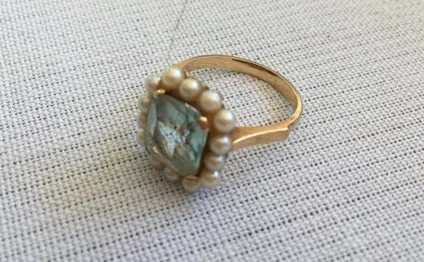
Nonetheless, he asked for her finger size and had a ring specially made for her in Nairobi. He posted it, being unable to meet in person at that time despite being only a few hours away geographically. It did not fit. He was mortified when he received this news in one of Patricia’s letters. He then told her he had decided to have a second try; he would source some aquamarines from Madagascar, the island where he had served earlier in the war. Patricia responded:
I am delighted you should have considered aquamarines. They are such gloriously coloured jewels with the sparkle and clearness which has never ceased to fascinate me.
The aquamarine ring fitted perfectly. Yet it came with poignancy. The young couple still had no idea whether Jack would be released from the army, not only because of his own vacillations. Their hopes were alternately raised and dashed by rumours about whether the release would or would not happen as the application as it made its way through official channels. Meanwhile, the couple met again in person and Patricia could show Jack his ring on her finger as they prepared for their marriage in September 1943.
*
There is one further addition to the ring’s story. In later life, Patricia had the ring altered – she added the cluster of pearls around the central aquamarine as shown in the picture. It had never quite been exactly what she wanted but she was too in love with Jack to tell him so at the time.
*
The ring itself will have a permanent home in the Western Australia Museum, Perth, along with other objects and jewellery donated by Patricia’s and Jack’s daughter, Jeannine Cook.
www.helenmolesworth.com
Precious by Helen Molesworth, Penguin, 2025